
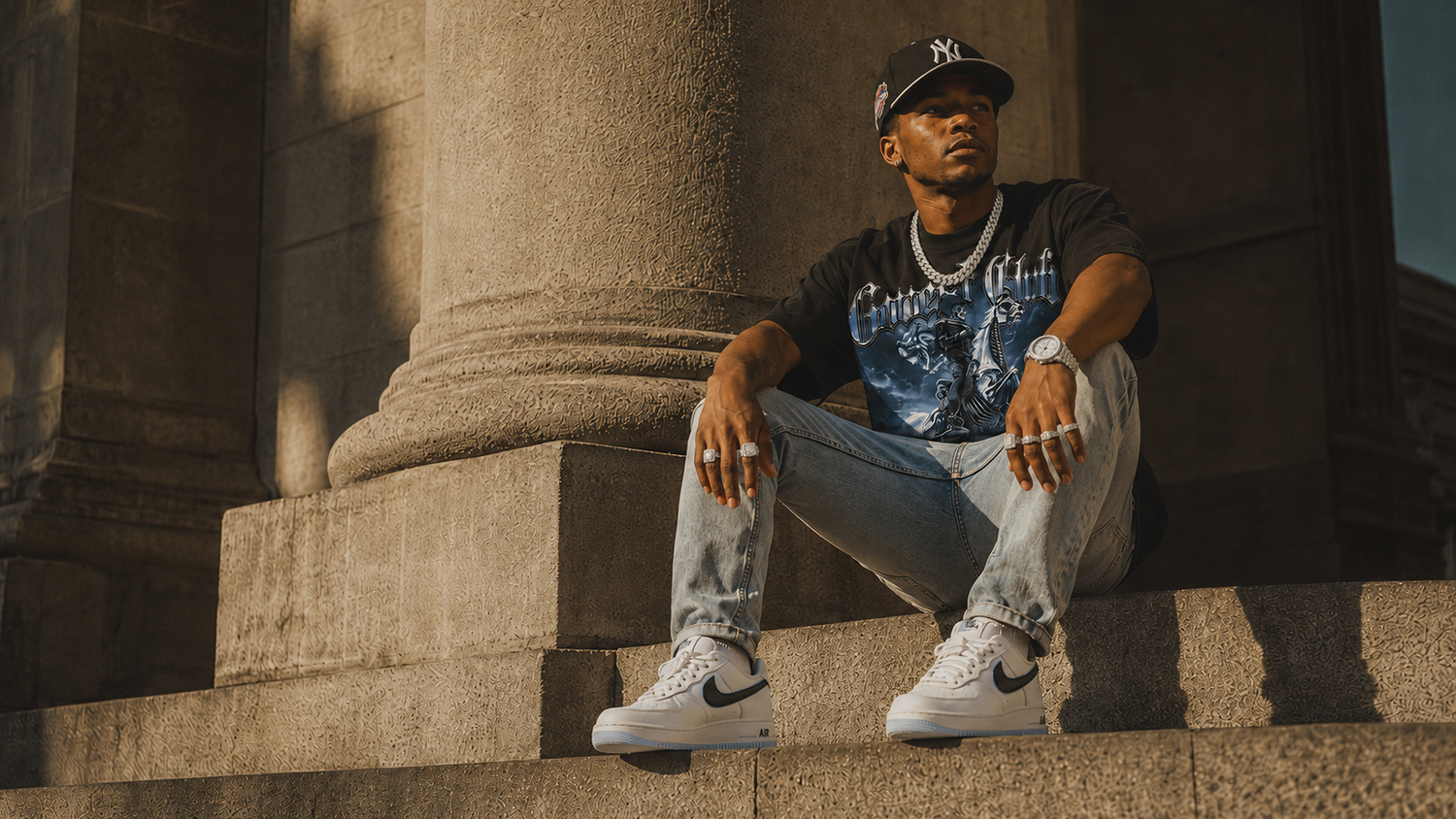
Let’s be honest with some real talk and that is you can’t really talk about streetwear without talking about hip-hop, they are synonymous with each other and have been connected for decades. Whether from Adidas shell toes, Nike AF1, Jordans, Converse and Kangol hats to oversized tees, baggy denim, and gold chains.
 |
 |
 |
 |
What started in the Bronx, New York City neighborhoods became a global fashion movement with hip-hop playing a huge role in taking the clothes that people were wearing in their communities and turning them into styles that everybody wanted.
Hip-hop style was always about three components:
Remixing,
Customization, and
Individuality.
And streetwear also follows this simple basic idea:
Take something basic.
Change it.
Make it yours.
When both combine, it becomes larger than life because it’s never about wearing something expensive but always about being original and having the right look.
 |
 |
 |
 |
 |
 |
 |
So, how exactly we got here? Let’s take a look at how Hip-Hop helped shape the streetwear that we now know today!
It Started on the Streets
It was back in the 70s in the Bronx when hip-hop emerged but even at that time the fashion around it was already being shaped by Black urban culture, sportswear and the changing attitudes of the era. Denim, kicks, tracksuits and casual clothing were actually already a part of everyday street style where hip-hop just gave it a new identity.
So, by the late 70s and early 80s, tracksuits, ballcaps, Kangol hats, gold chains, denim and fresh sneakers became the pieces that would become classic hip hop street style.
And let’s be clear, they weren’t simply just clothes but they became a way to show personality, a way of expressing yourself through your fit and your kicks did the talking about you whereas if you were an artist then your whole look became part of your identity.
This is still true and still a huge part of streetwear today.
Run-DMC Made Sneakers Part of the Culture
Now this is where it gets interesting because Run-DMC pushed it all in the upwards trajectory and at the core it was the sneakers. If you are a sneakerhead then you probably know where this is going.
Run-DMC started it all by wearing Adidas Superstar kicks with no laces and made the simple shell-toe sneaker a part of their signature look which resulted in them being closely associated with those kicks. Then it was followed by “My Adidas” in 1986 which instantly helped turn that relationship between hip-hop and sneakers into something much bigger because the influence was so big and huge that adidas eventually signed an endorsement deal with them.
This was probably the turning point and created a pathway for the brands showing them something they couldn’t ignore anymore: hip-hop artists could move product.
This was also the time when Air Jordan 1 OG was around and Michael Jordan was lighting it up on the court. Jordan’s signature line was up and running with Run-DMC giving more fuel to the fire.
This is exactly where sneaker culture really started to become a major part of hip hop streetwear. Kicks were no longer about basketball or to run around in but they were now becoming a statement and part of the fit.
Exactly this precise mindset continues to this day where every time someone builds their fit, they build it around a pair of Jordans, Air Force 1s or Dunks.
Hip-Hop Gave Brands a New Audience
The movement had started and it continued to grow during the 1980s and 1990s and there was no stopping it because artists weren’t wearing whatever was available but they were deciding to wear what they found cool, establishing a look.
Here Kangol is a perfect example because artists such as Kangol Kid, LL Cool J and Run-DMC, all of them helped make the brand's hats highly recognizable within the hip-hop communities.
Kangol Kid's endorsement is one of the earliest examples of a hip-hop artist creating a direct connection between music, fashion and a brand.
It is because of this, different brands were created to cater this specific audience in mind such as Cross Colours and Karl Kani, they became major names in 1990s urban fashion whereas FUBU, Rocawear, Phat Farm and Baby Phat showed how hip-hop could turn personal style into an actual business.
These brands quickly became household names because artists and producers realized fashion could extend their brands beyond music.
This is exactly where hip hop clothing brands started to become more than a trend and that’s when they became businesses built around the culture.
Dapper Dan Took It Somewhere Else
The Harlem designer Dapper Dan had other plans, and he took streetwear into a different direction.
The Dapper Dan’s Boutique opened back in 1982 and it quickly became known as a boutique for creating custom pieces which were inspired by luxury fashion logos and reshaping them around the tastes of his clientele. Dapper Dan’s work with hip-hop artists easily helped create a completely different approach to luxury and street style because he understood what people wanted which was: luxury but in their own way, in their style and what felt like them.
The bold designs became part of the visual language of hip-hop such as his work with Salt-N-Pepa. Dapper Dan’s approach showcased Black creativity and how it could take existing fashion ideas and remix them into something completely different.
That must sound familiar, doesn’t it?
It’s that exact same idea of mixing, customizing and making a fit your own.
That is the DNA of modern streetwear.
The 1990s Took Hip-Hop Fashion Mainstream
Hip-hop by the 1990s was everywhere influencing trends and fashion big time. You could say it was a storm that just kept going and building up. The oversized clothing became a major part of hip hop street style where artists rocked them and the young generation followed them helping popularize the bigger silhouettes.
The baggy jeans, oversized shirts and bold graphics were the fits.
During that exact same time, Black-owned brands were carving their own lane. As mentioned above Karl Kani and Cross Colours helped prove there was a huge market for clothing created with Black consumers and hip-hop culture in mind.
What these brands did was help establish an entirely new category of fashion while also changing the perspectives of how the industry actually viewed street-influenced clothing and the sneakers just kept getting bigger.
Jordan Brand, Nike and other athletic brands became deeply connected with the culture as artists continued giving certain kicks another level of visibility.
At this point in time, your kicks weren’t just completing your fit but They Were The FIT!
Hip-Hop Changed How We Think About Streetwear
The biggest influence hip-hop has had on streetwear is how it not only changed the perception regarding it but also how it made fashion personal.
It wasn’t about following certain traditional fashion rules but what felt right to you, and what made you express yourself establishing your look.
You could mix a designer jacket with jeans, throw on a pair of basketball sneakers, add a fitted or snapback, and make the whole thing yours.
Hip hop urban fashion also blurred the line between music, sports, fashion and everyday life. Streetwear is described as a mix of functional clothing, individualized styling and influences from hip-hop and other subcultures and fashion's biggest names couldn't ignore it. Sean Combs winning CFDA Menswear Designer of the Year Award in 2004 is a prime example that showed the fashion industry could no longer dismiss hip-hop fashion as something outside the mainstream.
So Where Are We Now?
If you look around today, you can easily see hip-hop's influence everywhere in almost every clothing you wear even if you don’t listen to hip-hop, you still either know about it or wear it.
Kicks are collectible, Graphic tees and hoodies are fashion statements. The oversized fits are the style norm whereas Luxury brands collaborate with streetwear designers all the time because that’s what is demanded by the masses including artists who themselves launch clothing lines that become brands in their own right.
And then even high fashion pulls inspiration from hip-hop and street culture where designers such as Virgil Abloh helped bring that relationship further into luxury fashion.
It is ever evolving and never slowing down and that’s why hip-hop fashion is never an old-school trend.
Hip-hop turned streetwear into a giant culture, it brought something simple into the spotlight with both influencing each other.
Everyday pieces turned into statements, sneakers became a major part of personal style and it gave Black designers, artists and entrepreneurs a bigger platform to build from.
In the end, that's what makes hip-hop streetwear different.
It was never just about what you wore. It was about how you wore it. Streetwear Fit:
Kicks: Jordan Men's Air Jordan 4 Retro "Toro Bravo"
Tee: Guapi Men's White Spider T-Shirt
Pants: Serenade Men's Abyss Jeans Pant
Frequently Asked Questions (FAQs)
1. How did hip-hop influence streetwear?
Hip-hop made personal style part of the culture. It popularized sneakers, tracksuits, oversized fits, graphic tees, hats and denims.
2. When did hip-hop fashion become popular?
Hip-hop fashion began in the 1970s and then grew rapidly through the 1980s and 1990s.
3. What are some popular hip hop clothing brands?
Some iconic names are Cross Colours, Karl Kani, FUBU, Rocawear, Phat Farm and Baby Phat.
4. Why are sneakers important to hip-hop fashion?
It is because artists made sneakers part of their signature looks such as Run-DMC and Adidas being one of the biggest examples.
5. Did hip-hop create streetwear?
No, it did not but it played a major role in bringing it to a bigger stage by popularizing and shaping it in how we see it today.
6. What is hip hop street style?
Basically it includes expressive staples such as sneakers, denims, tracksuits, oversized fits, hats, jewelry and other statement pieces.
7. How did rappers influence fashion?
What rappers did was made their personal styles recognizable which helped popularize specific brands, sneakers and trends.
8. Who is Dapper Dan?
Dapper Dan is a Harlem designer known for bold custom designs that connected Black style, hip-hop and luxury fashion.
9. Why is Black culture important to streetwear?
Black communities played a major role in shaping the styles, brands and trends central to modern streetwear.
10. Is hip-hop still influencing streetwear today?
Absolutely it is. Sneakers, collaborations, luxury fashion and artist-owned brands still show hip-hop's influence.


Leave a comment
All comments are moderated before being published.
This site is protected by hCaptcha and the hCaptcha Privacy Policy and Terms of Service apply.